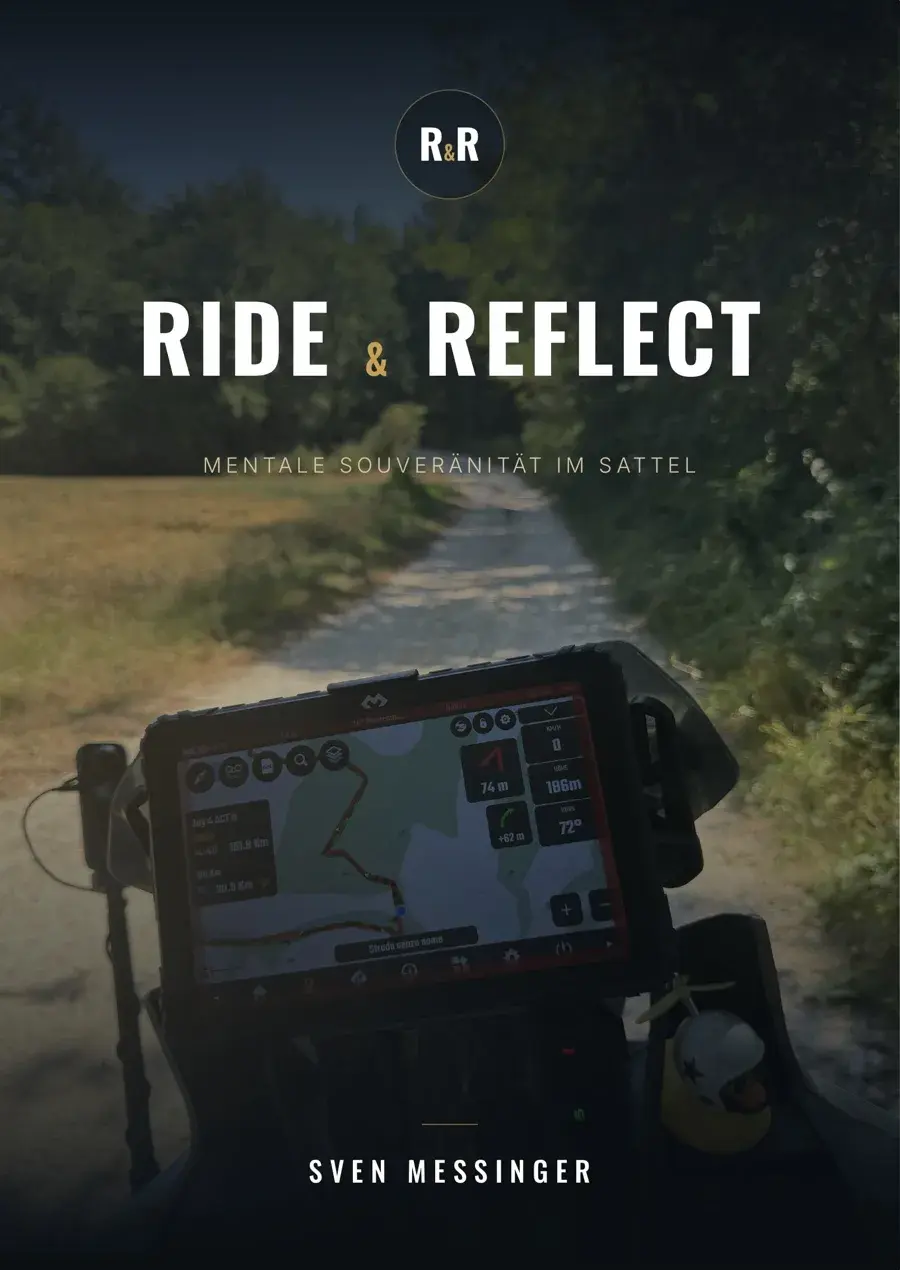
The book
Ride & Reflect – Mental Mastery in the Saddle
Scenes from practice, riding physics, brain research and simple tools for your next ride.
Work in progress · Release date to follow – Sven Messinger – The book is written in German.
From the foreword (translated): If you ride a motorcycle, you know the moments when everything fits together: the road, the weather, the bike and your head. And you know the other moments, when a corner is harder than yesterday although nothing has changed except you.
What it is about
It is about hands that grip too tightly, breathing that stops, eyes that rest on the wrong spot, and thoughts that are still in the last corner. None of this is a sign of weakness. These are reactions of a body doing its best. You can learn to notice them earlier.
The book is not a riding course. You learn riding technique from an instructor or on a course. This book complements that: it shows what happens inside you while you brake, steer and lean, and gives you simple tools to deal with it.
Everything is written in plain language. You need no background in physics or psychology and do not have to be an experienced rider.
How the book is built
Five modules with thirteen chapters. The modules build on each other, but each chapter can also be read on its own: if a particular riding situation is on your mind, start right at the matching chapter.
Module 1: Nervous system & body
Hands, breathing and body awareness.
- The death grip
- Breath as a rev limiter
- The body scan on two wheels
Module 2: Vision & cognition
Where you look and what you think about.
- Target fixation
- Thought stop
- Visor focus
Module 3: Terrain & comfort zone
Uncertainty, loose surfaces and a fresh start after a setback.
- Gravel mindset
- Coming back and blocks
Module 4: Long distance & flow
Endurance, recovery and the rare moments when everything flows.
- Fuel level and recovery
- Flow state
Module 5: Riding with others and under pressure
Group riding, dealing with an accident experience, night and bad weather.
- Riding in a group
- Dealing with accident experiences
- Night riding and weather
Every chapter follows the same pattern
- The scene: A short situation around riding.
- The riding: What happens on the bike and on the road.
- The brain: What happens in the body and in the head.
- The mirror: Where the same pattern shows up at work and in daily life.
- The tool: Exercises in three levels, from simple to demanding.
Each chapter also has a graphic that shows the essentials at a glance, and questions to write down. The studies and books the text draws on are listed by chapter in the appendix. The end of the book has an overview of all tools, a practice journal to fill in and a small Swiss glossary.
Reading sample: At the pass: Susten Pass
From chapter 1: The death grip (German original)
Anfang Juli, Passhöhe des Sustenpasses, 2’224 Meter über Meer. Die Sonne scheint, aber der Wind ist kühl und kommt in Böen von der Gletscherseite. In den schattigen Kehren hat der Asphalt noch die Feuchtigkeit vom Morgen. Auf der Passhöhe riecht es nach Abgas und nassem Stein, und irgendwo schlägt eine Fahne gegen ihren Mast.
Ich stehe mit meiner Maschine am oberen Ende des Parkplatzes und warte auf Marc. Er ist heute zum ersten Mal mit seiner neuen BMW R 1250 GS auf einem grossen Pass unterwegs. Die GS ist für solche Strassen gebaut: aufrechte Sitzposition, ein Fahrwerk mit viel Reserve, ein Motor, der schon von unten heraus zieht. Ich höre sie, bevor ich sie sehe, ein gleichmässiges Brummen, das vor der letzten Linkskurve kurz leiser wird.
Quer über die Fahrbahn zieht sich dort ein frisch geflickter Bitumenstreifen. Er glänzt dunkel in der Sonne, und von weitem lässt sich nicht sagen, wie glatt er ist. Marc sieht ihn spät. Seine Schultern gehen nach oben, die Hände greifen fester zu. Die GS richtet sich ein wenig auf und läuft weiter nach aussen, als sie müsste. Mit einem kurzen, festen Impuls am Lenker bringt er sie zurück auf seine Linie. Es passiert nichts, aber man sieht ihm an, dass er sich die Kurve anders vorgestellt hat.
Neben mir stellt er den Motor ab, nimmt den Helm ab und zieht die Handschuhe aus. Die Finger sind blass und steif. Als er die Hände ausschüttelt, merkt er, wie heiss sich die Unterarme anfühlen.
«Seltsam», sagt er. «Die GS soll solche Strassen eigentlich glattbügeln. Aber seit etwa zwanzig Minuten fühlt sich jede Kurve an, als müsste ich sie festhalten.»
«Dann hast du sie vermutlich festgehalten», sage ich. «Ich habe dich die letzten Kehren heraufkommen sehen. Die Ellenbogen standen nach aussen, die Schultern waren oben.»
Marc schaut auf seine Hände. «Ich dachte, das sei Konzentration.»
«Es fühlt sich auch so an», sage ich. «Aber das Fahrwerk kann nur arbeiten, wenn der Lenker ein bisschen beweglich bleibt. Schauen wir uns an, was da passiert.»
Who is it for?
For everyone who rides a motorcycle. Someone who has only just started finds the same patterns as someone who has been riding for decades, just in different places. There is also a chapter of its own for gravel riding.
The author
Sven Messinger coaches motorcyclists mentally in central Switzerland, around Zug, Lucerne, Schwyz and Zurich, one to one or in small groups. He is not a riding instructor and does not replace a course. He works with what happens in your head and body while you ride. His guiding principle: flow is no accident, it is a decision.
Let me know when it comes out
Enter your email address. You will be among the first to hear when the book is published and where to get it directly from Ride & Reflect.
Frequently asked questions
When will the book be published?
The date is not fixed yet. Everyone on the waiting list will hear first.
Where can I buy the book?
Directly from Ride & Reflect once it is published. The waiting list tells you when it is available.
Does the book replace a riding course?
No. The book does not teach riding technique. It shows what happens inside you while you ride and gives you simple tools for it. You learn riding technique from an instructor or on a course.
Do I need prior knowledge?
No. The book is written in plain language and needs neither physics or psychology knowledge nor much riding experience.
Do I have to read the book from front to back?
No. You can start right at the chapter that fits your situation. It is recommended to read one chapter, ride with its tool a few times, and only then move on.
Is the book available in English?
The book is written in German. This page describes it in English; the reading sample is in the original.
Prefer it in person?
A book can describe what happens in a corner. It cannot ride behind you and say a word at the right moment. That is what coaching is for.